
Técnicas Reunidas will lead a research project on plastic recycling as part of the CDTI’s Misiones program.
- The project, called ECLIPSE and clearly aligned with the goals of the circular economy, will help make it possible to utilize secondary raw materials derived from the recycling of complex polymeric waste, thereby reducing the use of natural resources and pollution caused by landfills.
- The Science and Innovation Missions program, overseen by the Center for Industrial Technological Development (CDTI), is part of the State R&D&I Plan approved in 2021 and aims to promote projects led by companies conducting relevant research to find solutions to the main cross-cutting and strategic challenges facing Spanish society.
- A total of 111 projects were submitted to this second call for proposals under the program, of which 37 were approved. The project led by Técnicas Reunidas was the third highest-rated in the call.
- The consortium that will carry out the research also includes seven other companies covering the entire plastic recycling value chain (ACTECO, PICVISA, REPSOL, CELLMAT TECHNOLOGIES, GRUPO COPO, SYNTHESIA, and SEAT), and the project office will be coordinated by CETIM Technology Center.
Madrid, January 18, 2022.—The Center for Industrial Technological Development (CDTI) has approved the inclusion of a research project focused on plastics recycling and led by Técnicas Reunidas in the second call for proposals of its Science and Innovation Missions program.
The project, named ECLIPSE and titled “Research into New Technologies for the Recycling and Recovery of Complex Plastic Waste,” was the third highest-rated in the call.
A total of 111 projects were submitted to this call, of which 24 proposed by large and medium-sized companies and 13 by SMEs were approved.
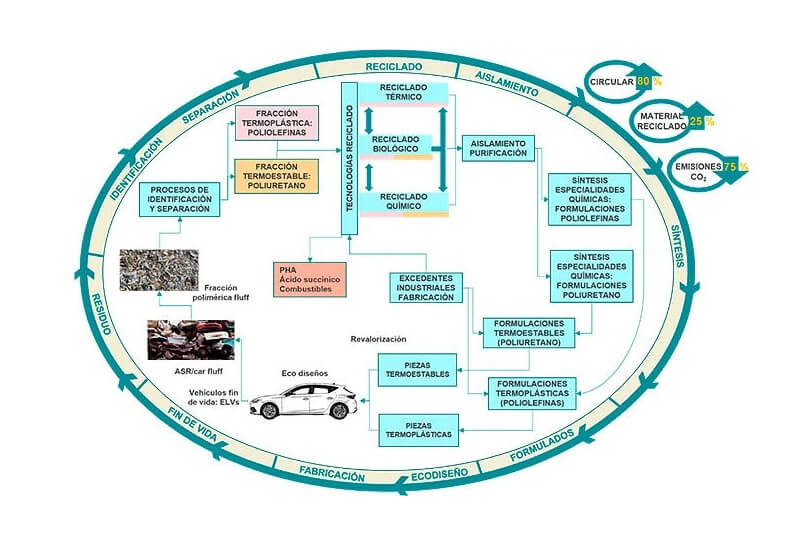
The objective of the ECLIPSE project is to investigate new technological pathways that facilitate the recycling and recovery of complex polymeric waste (plastics) and that represent a significant advance over the current state of the art in terms of separation, recycling, purification, and chemical synthesis to obtain new polymers suitable for reuse. In short, its goal is to develop a sustainable, circular, and comprehensive system for the recycling and revalorization of complex plastic waste—one that is versatile, tested in the automotive sector, and transferable to all strategic industrial sectors
This objective is particularly relevant today, as mechanical recycling of plastics—the most established technology due to its economic viability and simplicity—presents significant limitations for the recycling of complex plastics. Consequently, the ECLIPSE project could represent a significant step forward in addressing the environmental problems caused by plastic waste.
The project is fully integrated into circular economy strategies, as its development will enable the use of secondary raw materials derived from the recycling of complex polymeric waste, thereby reducing the use of natural resources, pollution, and landfills, and facilitating greater efficiency in recycling processes. Ultimately, it will contribute to the fight against climate change by reducing emissions and the carbon footprint, in line with the United Nations Sustainable Development Goals (SDGs) and the European Union’s Green Deal.
A project developed by a strong business consortium
The project will focus on research into the separation and identification of complex polymeric waste; combined thermal, chemical, and biotechnological recycling technologies; processes for the isolation and purification of chemical compounds of high industrial interest; the synthesis of specialty chemicals; polymer formulations; and eco-designs for products.
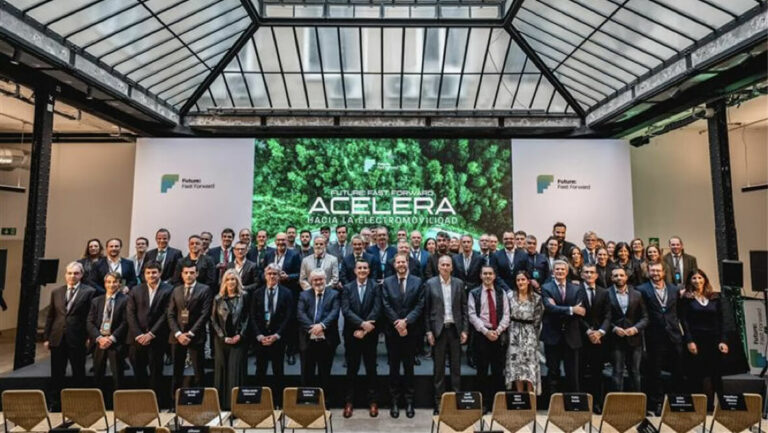
These tasks will be carried out by a consortium comprising eight companies—ACTECO PRODUCTOS Y SERVICIOS, CELLMAT TECHNOLOGIES, GRUPO COPO, PICVISA MACHINE VISION SYSTEMS, REPSOL, SEAT, SYNTHESIA TECHNOLOGY EUROPE, and TÉCNICAS REUNIDAS—led by the latter.
These eight companies, which possess proven expertise in various technological fields, will be responsible for the planned work according to the following distribution: industrial research on the composition and origin of automotive waste (SEAT) and industrial waste (GRUPO COPO); identification and separation of complex plastic waste streams (PICVISA and ACTECO); alternative recycling methodologies with substantial improvements based on thermal (TÉCNICAS REUNIDAS), biotechnological (REPSOL), and chemical (SYNTHESIA, ACTECO, and CELLMAT TECHNOLOGIES) treatments; purification and isolation stages for chemical units of interest (TÉCNICAS REUNIDAS); synthesis of thermoplastic and thermosetting specialty chemicals (SYNTHESIA and CELLMAT TECHNOLOGIES); polymer formulations (CELLMAT TECHNOLOGIES and GRUPO COPO), and eco-design and manufacturing of products (GRUPO COPO and SEAT).
CETIM is responsible for coordinating the project office and will also carry out, among other tasks, the analysis of complex plastic waste, support for partners in the eco-design of recycling technology pathways, collaboration in research on various thermal, chemical, and biological technologies, and the analysis of the final product proposals.
ECLIPSE also benefits from the cooperation of seven other research organizations: the Polytechnic University of Valencia (UPV), the University of Zaragoza (UNIZAR), the LEITAT Technology Center, the University of Valladolid (UVA), the Sarriá Chemical Institute (IQS), the Galician Automotive Technology Center (CTAG), and the National Supercomputing Center (BSC).
The project, which will run for 38 months, will have a budget of 7.3 million euros, with a grant of 4.4 million, equivalent to 59% of the budget.






The Science and Innovation Missions Program
The CDTI’s Science and Innovation Missions program is part of the State R&D&I Plan approved in 2021 and aims to promote projects led by companies that conduct relevant research capable of finding solutions to the main cross-cutting and strategic challenges facing Spanish society, improving the knowledge and technology base that Spanish companies rely on to compete, and stimulating public-private cooperation.
The program is fully aligned with the Spain 2050 initiative developed by the Spanish government, which outlines the necessary proposals to address the major challenges and problems Spain will face over the next 30 years.
The missions selected in this second call for proposals focus on key aspects of two of the nine challenges outlined in the Spain 2050 initiative, notably “Becoming more productive to grow better” and “Becoming a carbon-neutral, sustainable, and climate-resilient society.”
The ECLIPSE project has been funded by the Center for Industrial Technological Development (CDTI) under the 2021 call for proposals of the SCIENCE AND INNOVATION MISSIONS Program (Recovery, Transformation, and Resilience Plan), and is supported by the Ministry of Science and Innovation. The grant awarded to the project is funded by the European Union through the Next Generation EU Fund.