

The collaborative business R&D project entitled “Research into new technologies for the production and use of green hydrogen for the decarbonization of Spain’s energyintensive industry”, acronym HY2DEC, has been funded by the Center for Technological Development and Innovation (CDTI) and supported by the Ministry of Science and Innovation under the 2022 call of the Science and Innovation Missions program.
It is noteworthy that this project, framed within the Missions Program, achieved the third highest score—tied with second place—among all projects submitted in this call.
The Hy2DEC project aims to address the challenges of decarbonizing energyintensive industry through the sustainable production and use of green hydrogen and oxygen, as well as CO₂ capture to achieve a positive emissions balance. To this end, and in parallel with experimental research, Hy2DEC will conduct a study of the gaps and needs of energyintensive industrial processes to advance their decarbonization, together with an assessment of potential solutions provided by the technologies under study. All of this will be carried out in the context of two use cases involving intensive processes: the steel and ceramic industries.
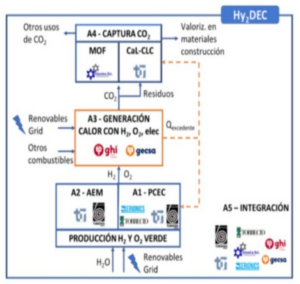
Figure 1 shows a schematic of the Hy2DEC project and the participation of the partners in the different research axes of the technologies studied.
The technologies to be investigated within this project can be grouped into three main areas:
Figure 1. Schematic of the Hy2DEC project, showing the research axes of the technologies studied in rectangular cells as process units, the activities in which they are addressed (AX), and the participating partners in each of them through their corresponding logos. In addition, the incoming and outgoing mass and energy streams of the process units are illustratively indicated with arrows.
Specifically, the participation of each of the companies in this project is as follows:
Acerálava (Tubacex Group):
Will research a new solution to reduce natural gas consumption and CO₂ emissions by optimizing overall energy consumption and identifying synergies for heat recovery and circularity through waste valorization.
Técnicas Reunidas:
Will research emerging technologies for the production of green hydrogen and oxygen through the development of anion exchange membrane (AEM) electrolyzers and protonic ceramic electrolysis cell (PCEC) electrolyzers. It
will also investigate technologies for capturing CO₂ from industrial emissions, as well as their integration into energyintensive industrial processes for decarbonization.
Torrecid:
Will research ceramic materials for ceramic membranes in electrocatalysis processes in PCEC for hydrogen generation, as well as the use of this hydrogen in frit melting processes to reduce emissions. Additionally, it will investigate CO₂ capture processes and their integration into melting furnaces.
GHI:
Will research kiln heating systems that use renewable energy sources and energyefficiency systems to reduce greenhouse gas emissions by at least 50%.
Gecsa:
Will research and develop a new power electronics solution to strengthen current solutions for electrolysis plants and melting furnaces.
Orchestra:
Will research a new CO₂ absorption technology using TAMOF1 at industrial scale in the form of pellets or granules that are mechanically stable and resistant to stress.
Kerionics:
Will research and develop a new generation of electrochemical cells capable of performing water electrolysis in a highly energyefficient manner and under milder conditions (temperatures below 600 °C).
The project, with a total budget of EUR 5,872,941, is scheduled for completion in 2025, at which point the scalability and industrialization of the prototypes developed by the participating entities will be conceptualized.

